
The Governing
Technology
How South Africa’s politicians learned to perform governance instead of deliver it — and why xenophobia is the most efficient technology available to them.
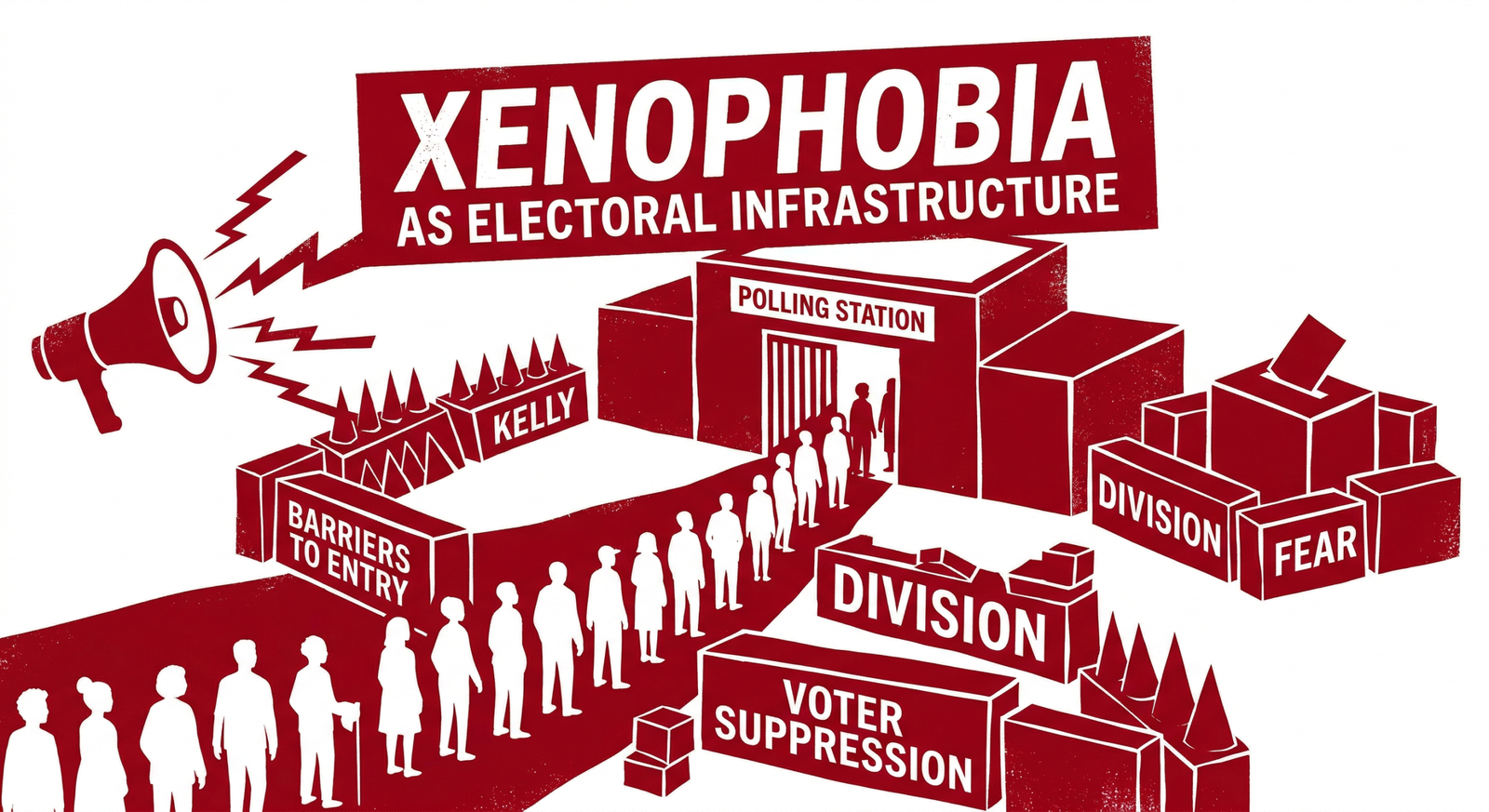
In September 2023, Herman Mashaba stood at an ActionSA policy conference and said he would “boot out undocumented migrants” from Johannesburg. The line got the applause it was designed to get. By February 2026, it had been sharpened into the central plank of his mayoral campaign — the load-bearing wall of his bid for executive control of the largest city in sub-Saharan Africa. It is worth pausing here, not on the politics of the statement, but on its architecture. A policy position was selected, tested, refined across two years, and deployed at scale. This is not rhetoric. This is engineering. [1]
The engineering has a flow. Municipal collapse comes first — 33,000 recorded pipe bursts across the Johannesburg infrastructure network, an R20.4 billion service backlog, youth unemployment at structural saturation in many wards. [2] From collapse comes public anxiety. From anxiety comes the simplification: the immigrant as causal agent. From simplification comes amplification. From amplification comes the final stage: offline action — vigilante raids, voting behaviour, policy pressure. Each stage feeds the next. No central coordination is required. [2]
Municipal Collapse
33,000 pipe bursts. R20.4bn service backlog. Youth unemployment above 60% in key wards. The substrate of failure is real, documented, and irreparable in the short term.
Public Anxiety
Residents experience the collapse daily. The dry tap, the unlit street, the unanswered billing query. Diffuse anger accumulates without a named target.
Simplification
The immigrant is named as causal agent. Digital networks seed and amplify the attribution. Locally experienced failure is attached to a visible, vulnerable group.
Amplification
Click-farms (Sri Lanka), coordinated hashtag campaigns (#PutSouthAfricansFirst), AI-generated content, and geopolitically funded media platforms industrialise the signal.
Offline Action
Vigilante raids. Healthcare blockades. Arson. Voting behaviour. Policy adoption by mainstream parties. The digital infrastructure produces physical outcomes.
In the Marlboro corridor — adjacent to Ward 109, IEC code 79800109, Buccleuch/Kelvin/Wendywood, Region E — a Zimbabwean family has lived in the same flat for seven years. The tap has been dry for three months, on and off. The WhatsApp group for the area carries a message. It says foreigners are using the water. It says the water is going to foreigners first. The message has been viewed hundreds of times. The family is in no group that discusses this. The discourse structurally requires their presence as a category and their silence as agents. [3]
This is not incidental. It is a design feature.
Politicians cannot fix municipal infrastructure quickly. Institutional repair is slow, expensive, unglamorous, and — crucially — invisible. A fixed water main does not generate shareable content. A functional billing system does not trend.
But a raid does.
What figures like Nhlanhla Lux of Operation Dudula and Gayton McKenzie of the Patriotic Alliance understood before the mainstream parties did is that state failure is not just a problem — it is raw material. The collapsed infrastructure becomes the stage. The vacant enforcement gap becomes the opening. Step into that gap publicly, visibly, and aggressively enough, and you are not just performing governance: you are creating a substitute for it that is, in electoral terms, arguably more effective than the real thing.
Call it the Theatre of Governance. It is not a metaphor. It is a system.
The Democratic Alliance took longer to arrive at this understanding, but Helen Zille’s explicit endorsement of mass deportation as rule-of-law principle — not as populism, she was careful to say, but as the rule of law — marks the moment the fringe conquered the centre. The lexical laundering is complete. You can now advocate for the same policy as Operation Dudula while insisting you are doing the opposite. [2]

The message in the Marlboro WhatsApp group was not written by a neighbour.
In Sri Lanka, a man named Geeth Sooriyapura operates a dedicated South Africa-focused click-farm. A 2025 Bureau of Investigative Journalism investigation confirmed his operation: anti-migrant content using Islamic-framing “patriot” accounts, producing AI-generated slop at scale, attribution confirmed. [4] Approximately 40,686 content items were seeded through these networks during the Chidimma Adetshina controversy alone. The algorithmic amplification sustains the narrative even in the absence of new trigger events. The machine runs on itself.
The sentiment shift costs $12,000 — approximately R215,000 — per campaign cycle. [4] The Intermarium Foundation, a US 501(c)(3), principal officer Andrzejczuk, IRS Form 990 public filing, purchases X click-advertising at that rate to amplify narratives via the Visegrád24 platform, which specialises in white genocide content. [6] There is no personal relationship required between Andrzejczuk and Marlboro. There is no meeting. There is a product and a price and a delivery mechanism and an outcome.
The Institute for Strategic Dialogue has tracked #PutSouthAfricansFirst as coordinated disinformation — not organic, not spontaneous. [5] More unsettling still: some of this infrastructure is not even South African. The hate is a globally traded product. Generative AI accelerates this. Realistic but fictitious visuals achieve virality at rates that vastly outpace the corrections that follow. The cognitive environment of the Johannesburg voter is, in the most literal sense, being contested by forces operating well beyond the city’s borders.
“The hashtags are physical tools. They build a wall in the mind. It is a globally traded product.”
Broken Pattern / BP-IWP-2026-002
Follow the money long enough and a pattern emerges.
Martin Moshal — Israeli-South African billionaire and trustee of the United Israel Appeal (Keren Hayesod) — has donated approximately R96 million to South African opposition parties between 2021 and 2024, an upgraded figure from an earlier partial disclosure of R44.5 million. [7] The funding consistently benefits parties that maintain neutrality or support on the Gaza conflict: DA, ActionSA, BOSA, IFP. The Oppenheimer family contributed approximately R10 million to ActionSA and R33.5 million to the DA across 2021–23. The Friedrich Naumann Foundation — German, liberal-aligned — channelled approximately R7.8 million to the DA in the same period, running a “Young Leaders Programme” with DA affiliates: seminars titled “Deconstructing Populism” and “Political Storytelling.” [7]
The causal link between those seminars and the DA’s subsequent manifesto language — “securing borders” framed as rule-of-law, not populism — is assessed as probable, not confirmed. [2] This funding does not purchase xenophobia. It purchases organisational infrastructure, narrative capacity, and political communication skills. The xenophobia emerges from the ecosystem those investments create.
None of this is a conspiracy. It is a structural reality: South African political discourse is being shaped, funded, and amplified by interests operating well beyond the interests of the South African voter. The local and the geopolitical are not separate systems. They are the same system. [2]

In March 2026, ActionSA MP Dereleen James gave an interview. She was asked about the label. “I am quite proud to be called xenophobic,” she said. [9] The statement was delivered in the context of Eldorado Park, of crime, of patriotism misdefined as hate. It was not a slip. It was a declaration of brand identity — the moment a parliamentary representative of a registered political party in a constitutional democracy placed the prefix proudly before a word defined in South African law as a human rights violation.
Twelve days later, in East London — KuGompo City — a Nigerian community leader named Solomon Ogbonna Eziko was crowned Igwe Ndigbo Na East London. [10] At least twelve vehicles were torched. Several buildings burned. The AbaThembu Royal Council described the coronation as an act of terror and a challenge to local sovereignty. ActionSA figures described it as provocative. [10, 11] The architecture of the event maps precisely onto the system flow: a municipal environment defined by chronic service failure, a public primed by two years of sustained anti-migrant narrative production, a trigger event, and a camera. No central direction required.
Meanwhile, in March 2026, Operation Dudula was blockading migrants from accessing public health clinics in Johannesburg. A High Court instruction had been issued. The blockades continued. [12]
“I am quite proud to be called xenophobic.”
Dereleen James, ActionSA MP — Daily Maverick Connect, March 2026 [9]
Note: Across DA, ActionSA, PA, and ANC — no documented internal opposition to hardening immigration positions was found in the public record. No debate. No dissent on record. [3]
What is not said in an election is often more revealing than what is.
No party presenting mass deportation as policy has produced a costed implementation plan. Home Affairs deported 46,898 people nationally in 2024/25 — a figure unverified at city level. [8] No timeline. No legal framework. The logistical impossibility of the promises being made is simply never discussed. It is structurally excluded from the debate. [3]
The migrants themselves — the people whose lives and livelihoods are the explicit subject of the discourse — are entirely absent from it. They are spoken about as threats by populists, or as victims by NGOs. Neither framing grants them political agency. Neither asks what they think. The discourse requires their presence as a category and their absence as voices. [3]
Census 2022 foreign-born population figures have been publicly dismissed as “deeply suspect” by political actors whose electoral interests are served by the dismissal. [3] When official statistics can be rejected without cost, you no longer have shared factual reality. You have competing narratives, and the one with the most algorithmic reach wins.
This is not a communications failure. It is a feature. A political system that has abandoned shared epistemology can never be held accountable against evidence, because evidence itself is contestable. The absence of shared facts is not a crisis to be managed. It is a resource to be exploited.
Those numbers are not arguments for authoritarianism. They are measurements of democratic exhaustion — the extent to which ordinary people have lost faith in the system’s capacity to produce results.
Into that exhaustion, the Theatre of Governance inserts itself. It does not offer results. It offers the feeling of results. Visible action. Visible enforcement. A body count of deportations, a camera rolling, a post going viral.
The race that follows is a race to the bottom. Parties that once defined themselves against this rhetoric now compete within its logic. The Overton window moves. And with each movement, the cost of returning to institutional norms — of running on policy rather than performance — increases. Post-election, there is no easy mechanism to put the genie back in the bottle. The audiences trained to see the immigrant as the source of state failure do not untrain easily.
What is new in 2026 is not xenophobia’s presence in South African politics but its architecture — the fact that it has been integrated into a functional system of digital amplification, geopolitical funding, manufactured crisis, and tactical performance that makes it self-sustaining and self-reinforcing.
It is no longer a message. It is infrastructure.
And infrastructure, once built, tends to persist long after the political moment that built it has passed.
The Zimbabwean family in Marlboro wakes up. The tap runs briefly this morning. The WhatsApp group says it is running because the landlord finally paid someone. The other group — the one they cannot see — says something different.

The system is not a conspiracy.
It is a market.
Everyone profits from the panic.
- ActionSA policy conference, September 2023; ActionSA Johannesburg mayoral campaign launch, February 2026. Public record / Eyewitness News.
- Broken Pattern. Xenophobia as Electoral Infrastructure: Johannesburg Municipal Elections 2026. Intelligence White Paper BP-IWP-2026-002, Version 3.0. 23 March 2026. [Primary source for system flow, rhetorical shift timeline, absence analysis, 73% distrust figure, and strategic synthesis.]
- BP-IWP-2026-002, Section 08: Absence Analysis. [Structural absence — no viable deportation infrastructure; voice absence — migrants excluded from discourse; dissent absence — no intra-party debate on record.]
- Bureau of Investigative Journalism (TBIJ). 2025. Investigation into AI-generated disinformation content; Geeth Sooriyapura, Sri Lanka-based click-farm operation. Attribution confirmed. Click-farm spend documented at $12,000/R215,000 per campaign cycle. 40,686 content items seeded during Chidimma Adetshina controversy.
- Institute for Strategic Dialogue (ISD). Academic tracking of #PutSouthAfricansFirst as coordinated inauthentic behaviour. MEDIUM confidence on full reach quantification.
- Intermarium Foundation. IRS Form 990 public filings. Principal officer: Andrzejczuk. Narrative amplification via Petzer / Visegrád24 platforms.
- Political Party Funding Act (PPFA) public disclosures, 2021–2023. Sources: Martin Moshal / Keren Hayesod / United Israel Appeal (R96M, upgraded from R44.5M); Oppenheimer family (~R10M ActionSA, ~R33.5M DA); Friedrich Naumann Foundation (~R7.8M DA). All figures from public financial record. Confidence: HIGH.
- Department of Home Affairs. Deportation statistics 2024/25. Note: national aggregate figure, unverified at city level.
- Daily Maverick Connect. 19 March 2026. “Does ‘what it means to be an MP’ include being a proud xenophobe?” — Dereleen James interview.
- FIJ NG. 30 March 2026. “Vehicles Damaged, Houses Burnt During Protest Against ‘Nigerian King’s Coronation’ in South Africa.”
- Guardian NG. 31 March 2026. “Violent protests in SA over controversial ‘Igwe Ndigbo’ coronation.” / Inside Metros. 20 March 2026. “ATM calls for probe after reported crowning of Nigerian Igwe in Eastern Cape.”
- Operation Dudula healthcare blockades, Johannesburg public health clinics. March 2026. High Court instruction issued; blockades continuing as at March 2026. Reported across multiple outlets.